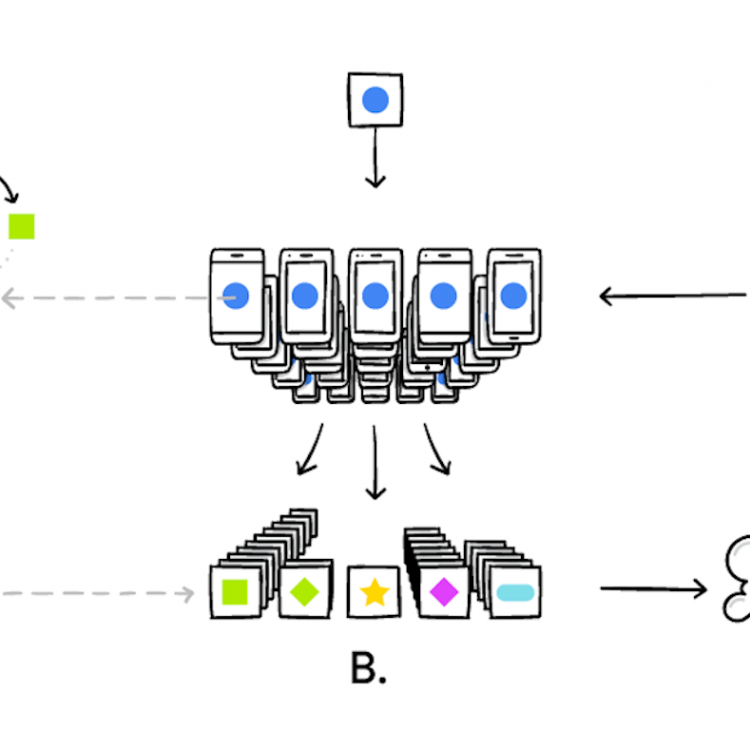

Federated learning (FL) is an emerging machine learning paradium to enable distributed clients (e.g., mobile devices) to jointly train a machine learning model without pooling their raw data into a centralised server. Because data never leaves from user clients, FL systematically mitigates privacy risks from centralised machine learning and naturally comply with rigorous data privacy regulations, such as GDPR and Privacy Act 1988.
Research projects in Information Technology
Displaying 121 - 130 of 215 projects.
Explainable AI (XAI) in Medical Imaging
Are you interested in applying your AI/DL knowledge to the medical domain?
This project focuses on the use of AI in Medical Imaging (e.g. CT, MRI, X-Ray, Ultrasound, etc). The work includes segmentation and classification; for example, segmenting tumour from the medical images, and then classify the grade of the tumour. We will use various Deep Learning techniques, such as CNN, and will experiment with a variety of Deep Learning frameworks, such as U-Net, ResNet, etc.
Development of AI based Point of Care MRI
Portable point of care medical devices have revolutionised the way in which people receive medical treatment. It can bring timely and adequate care to people in need but also opens up the opportunity to address the healthcare inequality for the rural and remote.
Machine Learning for faster and safer MRI and PET imaging
Machine learning has recently made significant progress for medical imaging applications including image segmentation, enhancement, and reconstruction.
Funded as an Australian Research Council Discovery Project, this research aims to develop highly novel physics-informed deep learning methods for Magnetic Resonance Imaging (MRI) and Positron Emission Tomography (PET) and applications in image reconstruction and data analysis.
Guarding On-device Machine Learning Models via Privacy-enhancing Techniques
On-device machine learning (ML) is rapidly gaining popularity on mobile devices. Mobile developers can use on-device ML to enable ML features at users’ mobile devices, such as face recognition, augmented virtual reality, voice assistance, and medical diagnosis. This new paradigm is further accelerated by AI chips and ASICs embedded on mobile devices, e.g., Apple’s Bionic neural engine. Compared to cloud-based machine learning services, on-device ML is privacy-friendly, of low latency, and can work offline. User data will remain at the mobile device for ML inference.
Social, Political, Economic Studies of Technology and FIRE (Finance, Insurance, Real Estate)
This research project is part of a DECRA fellowship funded by the Australian Research Council for a project titled, Everyday Insurtech: Impacts of Emerging Technology for Insurance. The fellowship will study the development, adoption, and implications of digital technology and insurance—such as tools for capturing individualised data about behavioural risk factors and automating enforcement of policy conditions.
STEM Making for all: including people with a disability
People with disabilities are excluded from the assistive technology creation process because the methods and tools that are used are inaccessible. This leads to missed opportunities to create more accessible technologies for everyone including assistive technologies. This project will engage people with disabilities in the technology creation process at many levels, from engagement activities, input into designs and creation of technology and the facilitation of independent making of assistive technologies.
Science as a public good: improving how we do research with game theory and computation
Science is a public good. The benefits of knowledge are or should be available to everyone, but the way this knowledge is produce often responds to individual incentives [1]. Scientist are not only cooperating with each other, but in many cases competing for individual gains. This structure may not always work for the benefit of science.
Privacy-Preserving Machine Learning
With success stories ranging from speech recognition to self-driving cars, machine learning (ML) has been one of the most impactful areas of computer science. ML’s versatility stems from the wealth of techniques it offers, making ML seem an excellent tool for any task that involves building a model from data. Nevertheless, ML makes an implicit overarching assumption that severely limits its applicability to a broad class of critical domains: the data owner is willing to disclose the data to the model builder/holder.
Learning from massive amounts of EEG data
The existing deep learning based time series classification (TSC) algorithms have some success in multivariate time series, their accuracy is not high when we apply them on brain EEG time series (65-70%). This is because there is a large variation between EEG data of different subjects, so a TSC model cannot generalise on unseen subjects well. In this research project we investigate self-supervised contrastive learning to encode the EEG data. This way we can better model the distribution of our EEG data before classifying it to different mental status. See a recent work here [1].