
This Masters or PhD project aims to explain the uncertainty of Machine Learning (ML) predictions. To this effect, we must quantify uncertainty, devise algorithms that explain ML predictions and their uncertainty to different stakeholders, and evaluate the effect of the conveyed information.
Research projects in Information Technology
Displaying 81 - 90 of 220 projects.

Long-term Human-robot Social Interactions Using Compositional Multimodal Agent Models at Monash University
We are excited to offer a fully funded PhD position at the Faculty of Engineering, Monash University (Australia). This project focuses on developing new algorithms to equip social robots with the social, cognitive, and communicative skills needed to autonomously engage in meaningful, long-term human-robot interactions.
Supervisor: Dr Hamid Rezatofighi

SmartScaleSys (S3): AI-Driven Resource Management for Efficient and Sustainable Large-Scale Distributed Systems
In SmartScaleSys (S3), we aim to design and build resource management solutions to learn from usage patterns, predict future needs, and allocate resources to minimize latency, energy consumption, and costs of running diverse applications in large-scale distributed systems. This project offers researchers and students a chance to explore cutting-edge concepts in AI-driven infrastructure management, distributed computing, and energy-aware computing, preparing them for impactful roles in industry and research.
Supervisor: Dr Mohammad Goudarzi
Detect and monitor extremist rhetoric or planned criminal activities using social media and dark web multimodal data
This project aims to employ advanced machine learning techniques to analyse text, audio, images, and videos for signs of harmful behaviour. Natural language processing algorithms are utilized to examine vast amounts of textual data, identifying keywords, phrases, and sentiment that may indicate extremist views or intentions. Analysing audio involves techniques such as speech recognition, keyword analysis, contextual analysis, audio feature extraction, and machine learning models to identify and assess potentially dangerous content.
Supervisor: Assoc Prof Thanh Thi Nguyen

An AI analytics workbench for protein structural characterisation
Our industry partners are developing software for automation of Hydrogen Deuterium Mass Spectrometry, which can connect structure, behaviour and function of proteins, for understanding diseases and developing drug and vaccine treatments.
Modern AI techniques can provide powerful models for classifying and understanding protein structures, but expert supervision is required in the development, training and deployment of these models into automation scenarios.
Supervisor: Prof Tim Dwyer

XR-OR: Extended Reality Analytics for Smart Operating Rooms and Augmented Surgery
We seek to explore opportunities and challenges for the use of Extended Reality (XR) technologies (including augmented and virtual reality, as well as mixed-reality interaction techniques) to support surgeons, operating room technicians, and other professionals in and around operating room activities. Particular areas that may be explored are:
Supervisor: Prof Tim Dwyer
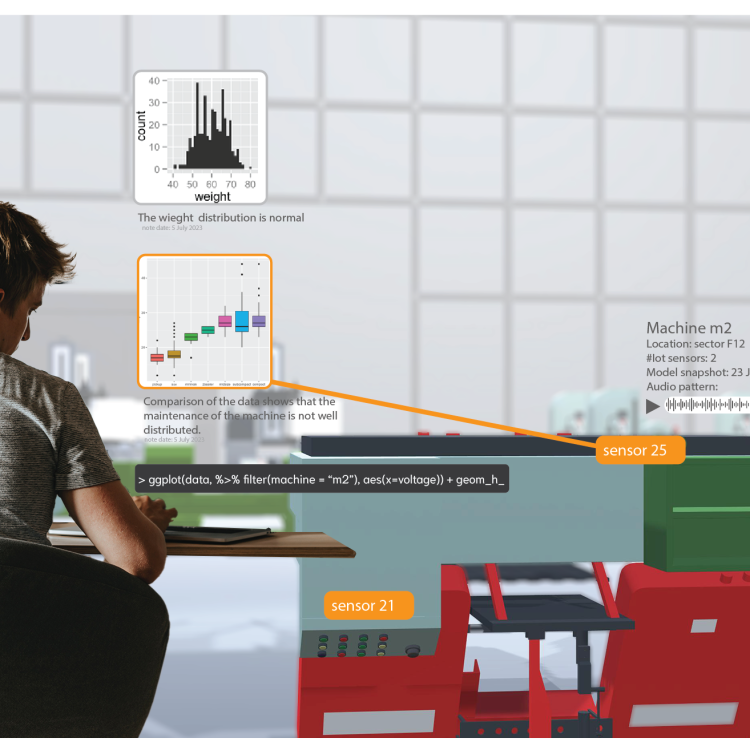
Immersive Contextual Data Analytics
This PhD project aims to leverage innovative spatial computing technologies and proposes Immersive Contextual Data Analytics (ICDA) as a method to address contextual analysis challenges by bringing rich contextual information to the analyst’s workspace. Despite the technological capability to support ICDA, there remains a lack of fundamental human-computer interaction research and usability design principles to realise practical and effective applications, particularly concerning how data visual analytics translates to this new method.
Supervisor: Dr Kadek Satriadi
Guidelines and Rubrics for developing mobile sensing apps in health care
Mobile and continuous health monitoring has seen major advancements in recent years. The capabilities of current mobile phones and their built-in sensors have inspired many mobile sensing applications for monitoring individuals' health, activities and social behaviour. Yet, there is a lack of common and standard guidelines in developing mobile sensing apps (from both software development and UI perspectives) and their evaluation.
Supervisor: Dr Pari Delir Haghighi
A multi-layer architecture (the mobile-edge-cloud continuum) of federated learning for mobile health sensing data
Current federated learning architectures in mobile healthcare are limited to a centralised model without considering the full continuum of mobile-edge-cloud. Additionally, to support different data privacy needs of patients as well as the limitations of mobile environments, there is a need for considering a multi-level federated learning architecture for the mobile-edge-cloud continuum.
Supervisor: Dr Pari Delir Haghighi
An online assessment framework for reliable generative AI-driven recommender apps in chronic disease management
Chronic conditions are becoming a serious global and national health problem. Recommendation systems play an important role in supporting patients in managing their long-term health issues. They generally rely on expert rules or machine learning models to provide health advice. Recently, generative AI tools, such as ChatGPT, have become a popular focus of research. In healthcare, they show strong potential to facilitate the process of generating health-related advice without the need for predefined rules or training data. Yet, their reliability remains a serious concern.
Supervisor: Dr Pari Delir Haghighi