
Play is fundamental and one of the main methods children learn skills, gain independence, and practice daily tasks that lead into adulthood. TechToy Library is an innovative, co-designed initiative creating toys specifically designed for children with cerebral palsy, empowering them to play, learn, and connect. Through collaboration with families, allied health professionals, and people with lived experience, the project develops inclusive toys using cutting-edge technologies like augmented reality and 3D customisation.
Research projects in Information Technology
Displaying 11 - 20 of 220 projects.

TechToys co-designed with children with cerebral palsy: Reimagining play
Supervisor: Dr Kirsten Ellis
The Conversational Refreshable Tactile Display: Multimodal AI for people who are blind or have low vision
For decades, the primary way people who are blind or have low vision (BLV) interact with computers has been through screen readers. These linearise an application or document interface, presenting content as synthetic speech or on a single-line braille display, which the user navigates using keyboard shortcuts or touch gestures on a smartphone. Screen readers have a major limitation: they cannot show graphics. Instead, they rely on alternative text descriptions, which are often incomplete or inadequate.
Supervisor: Prof Kim Marriott

Human-Centred Multimodal World Models for Socially Intelligent Embodied Agents
Human Centred AI
World models are becoming an important direction in artificial intelligence and robotics. Instead of responding only to what is currently observed, an intelligent agent can use an internal model of the world to represent its surroundings, anticipate what may happen next, and reason about the consequences of possible actions. This ability is particularly important for robots operating around people, where behaviour is dynamic, uncertain, and strongly influenced by context.
Supervisor: Dr Adamu Muhammad Buhari
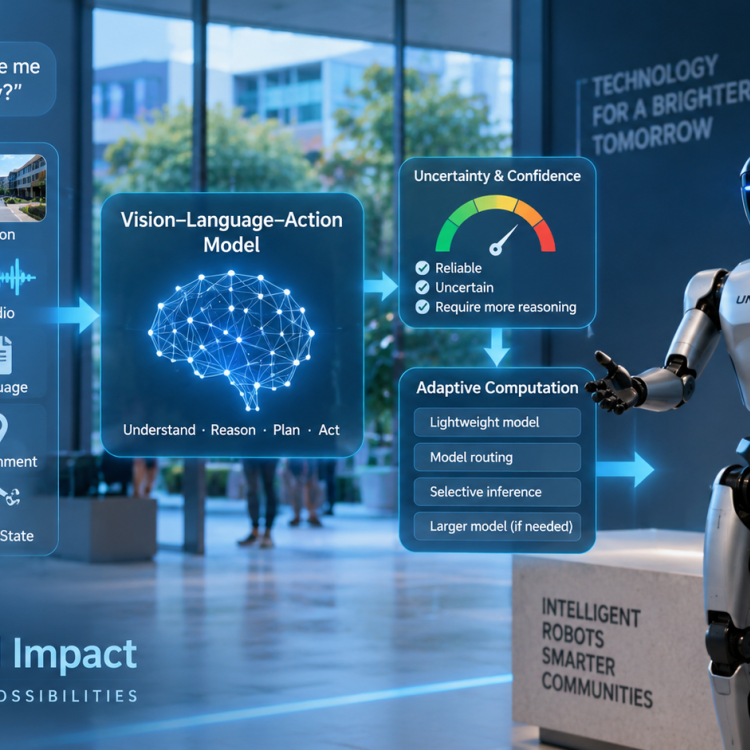
Trustworthy and Resource-Adaptive Vision-Language-Action Models for Embodied AI
Vision-Language-Action (VLA) models are changing the way robots perceive their surroundings, interpret instructions, reason about tasks, and interact with the physical world. By bringing vision, language, and action into a common framework, these models offer a promising route towards robots that can operate more naturally in complex and unfamiliar environments.
Supervisor: Dr Adamu Muhammad Buhari
AI-based classification of user behavioural responses in VR systems
Presence is the subjective feeling of "being there" that differentiates virtual reality (VR) systems from other forms of computer interfaces, and has long been thought to be beneficial in applications of VR such as training and psychotherapy. The quantification of presence has largely revolved around the use of subjective questionnaires, despite longstanding problems with existing questionnaires.
Supervisor: Dr Rob Teather

[Malaysia Campus- VPSSP] An AI-Informed Planetary Health Framework for Equitable AMR Risk Mitigation
This project develops an AI-informed, community-grounded framework to understand and mitigate antimicrobial resistance (AMR) risks within a planetary health context. Building on the risk modelling from Project 1, we will conduct focus groups and interviews with communities in high- and low-risk zones to capture local knowledge, behaviours, and risk perceptions related to AMR.
Supervisor: Dr Sicily Fung Fung Ting
Longform generation and multimodal learning for Biomedical NLP
Large language models increasingly adapt using external feedback to alter inference-time behaviour, persistent state or model parameters. However, the signals that drive these changes may be noisy, biased, incomplete, delayed, correlated with the model’s own errors, or progressively underused during long-context and multi-step processing. This project studies reliable adaptation as a general feedback-mediated problem by distinguishing failures at the feedback source, during signal transmission and during model updating.
Supervisor: Assoc Prof Sarvnaz Karimi
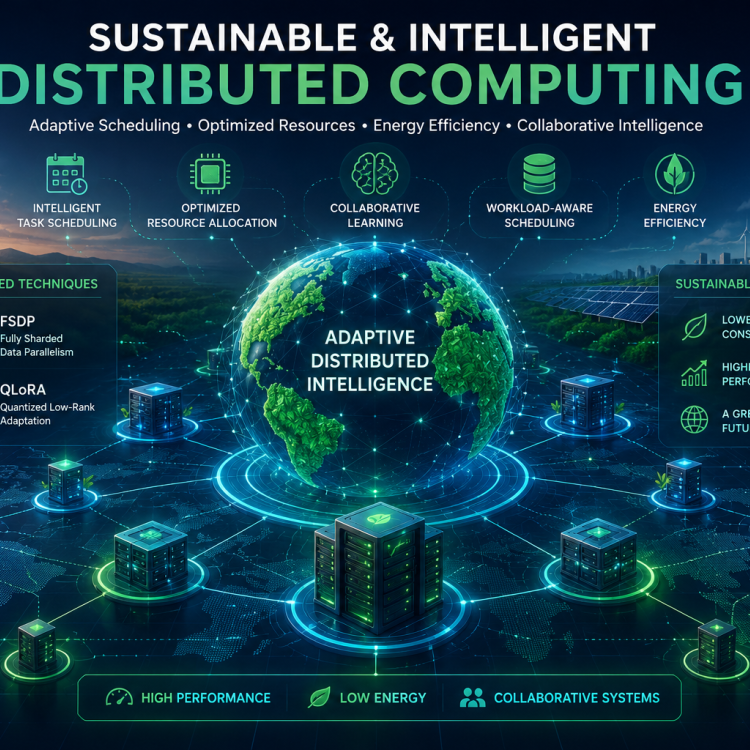
Energy-Optimized Distributed Computing
This research aims to design a sustainable framework for optimizing distributed computing systems to enhance performance while minimizing energy consumption. Existing scheduling algorithms often fail to consider workload heterogeneity, resulting in suboptimal performance and increased energy costs. This proposal addresses these gaps by introducing dynamic task assignment and workload-aware scheduling algorithms that dynamically adapt to system demands.
Supervisor: Dr Isma Farah Siddiqui
Bioinformatics analysis of spatial data in congenital heart diseases
Congenital heart disease affects 1 in 100 babies. Spatial gene expression patterns are critical to understand how the heart develops and what underlying genetic patterns are behind heart malformation. High-throughput spatial temporal data have been recently generated with spatial transcriptomics technologies. Capitalising on these rich datasets, we aim to build a custom analysis workflow in which the cells are profiled with precise spatial gene expression information. The student will provide fundamental contribution to of this project, by:
Supervisor: Assoc Prof David Dowe

[Malaysia] - Human-Centred Explainable Medical Artificial Intelligence using Large Language Models
Human Centred AI
Recent advances in artificial intelligence have produced highly accurate diagnostic models across a wide range of medical applications. However, these systems often provide little insight into how decisions are made, limiting clinician confidence and adoption in healthcare settings.
Supervisor: Dr Fuad Noman