
This project involves model-based depth of anaesthesia monitoring using autoregressive moving average modelling and neural mass and neural field modelling of the electroencephalographic (EEG) signal. This will be achieved through frequency domain and time domain state and parameter estimation techniques to infer model states and parameters in real time to simultaneously track the anaesthetic brain states while inferring underlying physiological changes.
Research projects in Information Technology
Displaying 71 - 80 of 129 projects.

Epileptic Seizure Prediction
Seizure prediction algorithms will be developed using the one-of-a-kind ultra-long-term human intracranial EEG dataset obtained from the Neurovista Corporation clinical trial of their Seizure Advisory System, or data from other implantable or wearable devices. This involves consideration of both feature-based machine learning or data science approaches and neural mass parameter estimation approaches to classify the EEG and predict seizures. Recent approaches focus on critical slowing as a marker for seizure susceptability and the influence of brain rhythms.
Supervisor: Dr Levin Kuhlmann
End-to-End Prediction and Optimisation
Optimisation methods, such as mixed integer linear programming, have been very successful at decision-making for more than 50 years. Optimisation algorithms support basically every industry behind the scenes and the simplex algorithm is one of the top 10 most influential algorithms. Major success stories include rostering nurses in hospitals, managing chains of organ transplants, planning production levels for manufacturing, routing delivery trucks for transport, scheduling power stations and electricity grids, to name just a few.
Supervisor: Dr Edward Lam
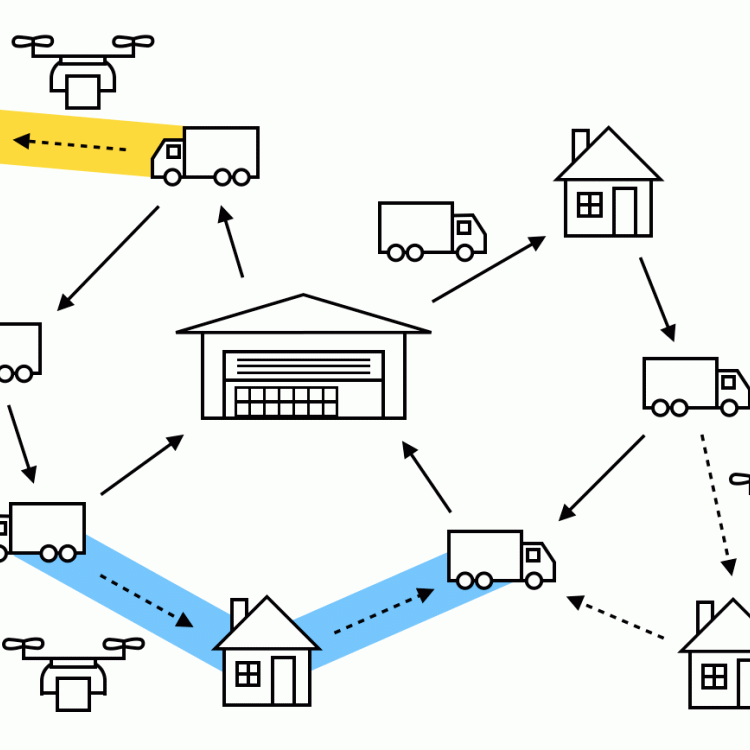
Branch-and-Cut-and-Price Algorithms for Computing Cost-Effective and Time-Efficient Delivery Routes for Trucks and Drones
Transport and logistics businesses today use a large fleet of trucks and vans to deliver packages widely across a city. Deciding which package should be loaded on to which vehicle and deciding which package should be prioritised are surprisingly difficult computational tasks. State-of-the-art high-performance algorithms are used to calculate routes for the vehicles in order to minimise costs and maximise efficiency.
Supervisor: Dr Edward Lam
[Malaysia] - Integration of heterogeneous biomedical data for robust and interpretable prediction
Many machine learning (ML) approaches have been applied to biomedical data but without substantial applications due to the poor interpretability of models. Although ML approaches have shown promising results in building prediction models, they are typically data-centric, lack context, and work best for specific feature types. Interpretability is the ability of an ML model to identify the causal relationships among variables. It is crucial for uncovering new insights, justifying a model performance and ultimately building trust in users for further applications.
Supervisor: Dr Ong Huey Fang
Creating a turnkey solution to classify, predict and simulate behaviour from videos of rodents
Introduction
Supervisor: Assoc Prof David Dowe
Combating antimicrobial resistance through use of artificial intelligence and genomics
Antimicrobial resistance (AMR) is one of the most significant and immediate threats to health in Australia and globally. We are working on harnessing new technologies such as artificial intelligence and next-generation sequencing and to improve the diagnosis, treatment and prevention of AMR infections.
The specific aims of this project are:
1. Rapidly identify AMR and predict treatment responses through use of genomics and machine learning in a clinical context.
Supervisor: Assoc Prof David Dowe
Active Learning for Language and Multimodal Applications
This PhD project aims to mitigate the data scarcity of new NLP and Multimodal applications by developing novel active learning algorithms. In this project, the student will leverage large foundation models, such as ChatGPT and GPT4, incorporating the cutting-edge techniques in the other areas, such as reinforcement learning, causality and GFlowNets, to devise novel active learning algorithms for NLP and multimodal applications.
Supervisor: Assoc Professor Reza Haffari

Medical AI Exploration with Machine Learning and Robotics
PhD Studentship Description:
Supervisor: Assoc Prof Zongyuan Ge
Development of AI based Point of Care MRI
Portable point of care medical devices have revolutionised the way in which people receive medical treatment. It can bring timely and adequate care to people in need but also opens up the opportunity to address the healthcare inequality for the rural and remote.
Supervisor: Assoc Prof Zhaolin Chen