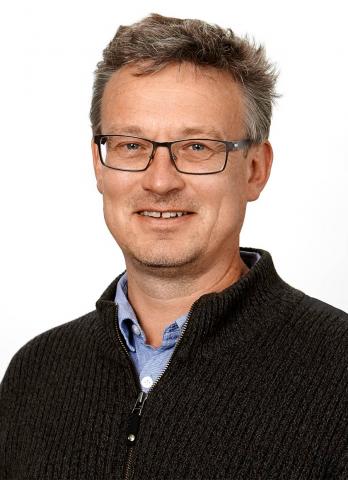
Primary supervisor
Bernd MeyerResearch area
Data Science and Artificial IntelligenceOur research group tries to decipher the rules that govern decision making in socially living animal groups.
One particularly important type of collective decision making is task allocation: how does a group allocate individuals to different tasks so that the goals of the groups are achieved. Many groups self-organise without a central controller to achieve this: group-level behaviour emerges from the actions of independent acting individuals, who only have limited, locally information on what is going on.
Such self-organised behaviour is, for example, the basis of how migrating birds steer their flocks, how fish schools hunt, and how ants swarm when they forage. Ants are arguably the most important model system for the study of self-organised behaviour. An ant colony must solve complex task allocation problems: a broad spectrum of tasks, from nest building, hygiene, and brood care to foraging, exploration, and defence needs to be addressed simultaneously so that the colony can thrive and survive. Task allocation in ant colonies is almost exclusively self-organised and even after many years of research it is still a fascinating puzzle how a colony manages to achieve its goals without any central control in the presence of ever changing environmental conditions and internal colony demands.
The project investigates the mechanisms of self-organised task allocation in insect colonies. How do independently acting insects achieve a colony-wide optimal or at least adequate allocation of workforce? How is the required information communicated in the colony?
It will also touch on one of the deepest questions: Why does a colony allow many of its workers to be free-riders, who apparently do not contribute any useful work to the colony but consume its shared resources? This is a most puzzling question —— typically, a large fraction of workers in social insect colonies are just “lazy”. There appears to be no good biological justification for this to have evolved, and the answer to this question may hold the ultimate key to understanding task allocation in depth.
The project builds on well established computational and mathematical modelling techniques to achieve its aims. Departure points are Evolutionary Game Theory and reinforcement learning, supported by agent-based simulations and optimisation models. We work closely with biologists who provide experimental data to verify the theory, and a certain amount of interest in interdisciplinary work is required.
Required knowledge
Interest in Interdisciplinary Work, strong mathematical background, reasonable coding skills, preferably experience with scientific computation, numerical methods.